
Harmannsdorf Castle, the former home of Nobel Peace Prize winner Bertha von Suttner, remains a significant site of pacifist history. During a recent visit Jonathan Haude, former “Auslandsdiener" at the Peace Palace in The Hague, was guided through the estate by its owner, Dieter Glawischnig, one of the founders of the International Bertha von Suttner Association. The castle, including Suttner’s preserved study and the historically rich granary, serves today as a venue for cultural and academic events promoting dialogue on peace.
By Jonathan Haude
About an hour’s drive from Vienna lies the picturesque Harmannsdorf Castle, once owned by the Suttner family. While looking out onto sandstone sculptures and an expansive park, Bertha von Suttner wrote one of the most influential works in pacifist history: “Lay Down Your Arms”.
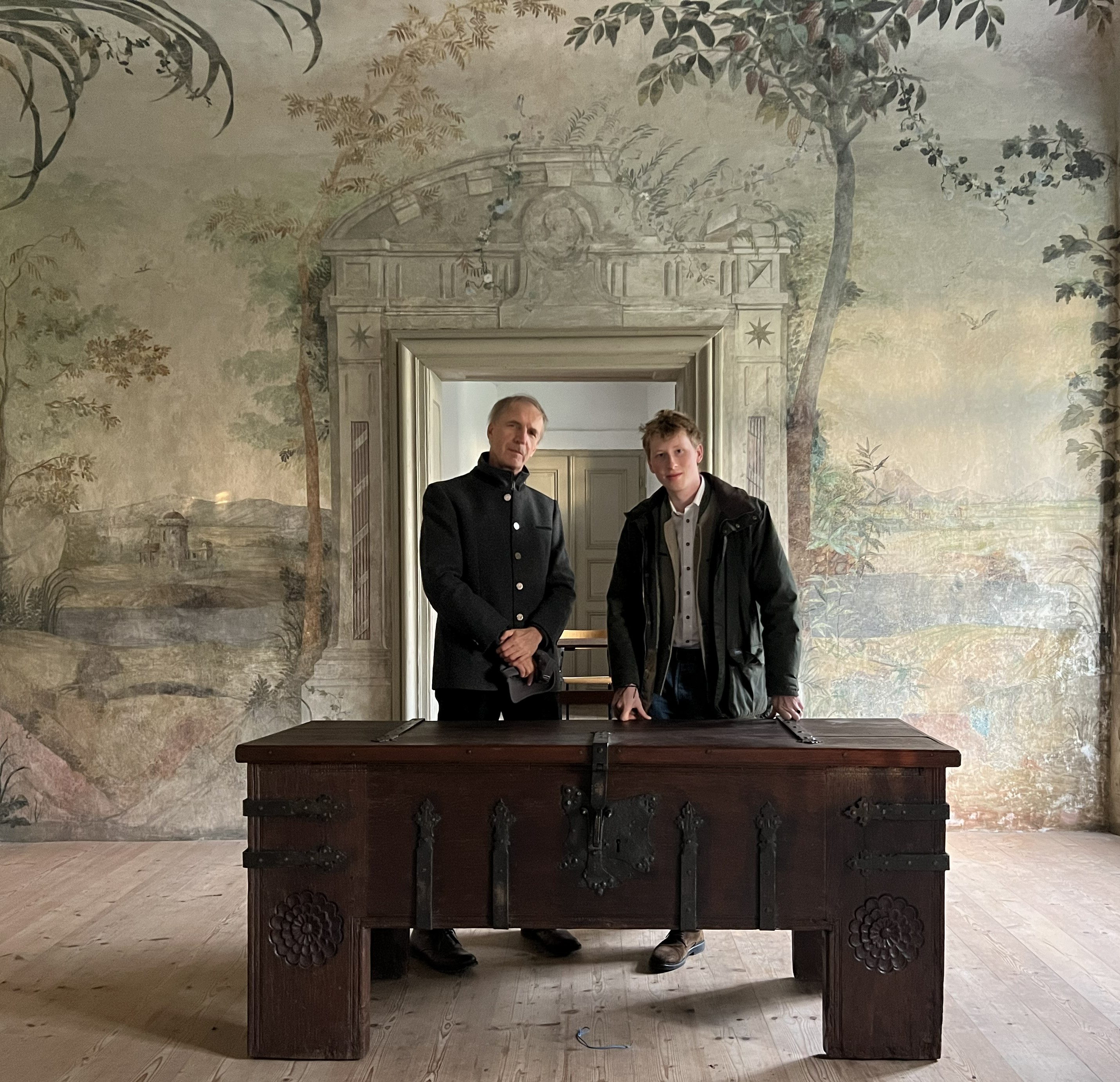
Recently, former “Auslandsdiener” at the Carnegie Foundation and member of the Austrian Service Abroad Jonathan Haude visited the historic residence where Suttner spent most of her life. Upon arrival, he was greeted by Dieter Glawischnig, the current owner of the castle and one of the founders of the International Bertha von Suttner Association.
Glawischnig led the way through the courtyard and up a grand staircase before settling in the castle’s living room. The atmosphere of the centuries-old estate— full of history and memory — was almost tangible. When asked what it feels like to live in a place so rich in history, Glawischnig reflected:
“It has changed over the years. In the beginning, it was an adventure on the one hand, but on the other hand, it felt like a burden because of the rough condition of the castle. Now, I see it as a certain privilege.”
The tour continued to Bertha von Suttner’s former office, where a portrait, painted by Austrian painter Adrienne von Pötting, of Suttner hangs. Surrounded by these relics, one can almost feel transported back in time — as if the castle itself were a living time capsule.
Bertha von Suttner’s influence on the global peace movement remains monumental. Not only was she the first woman to receive the Nobel Peace Prize, but she also played a crucial role in inspiring Alfred Nobel to establish the award. Throughout her life, Suttner maintained close ties with other prominent pacifists such as Henry Dunant and Aletta Jacobs.
“I definitely see the castle as a place of dialogue and encounter in the context of the peace movement,” Glawischnig explained. “We have collaborated with researchers and host a permanent exhibition in the granary, which features display boards donated by Georg Hamann, the son of historian Brigitte Hamann.”
The granary, a unique part of the castle complex, once served as grain storage but was already used during Suttner’s time for theater performances and cultural events. Suttner herself often took part in these plays. The interior, decorated with frescoes and secco paintings depicting lush, exotic landscapes, evokes a paradise-like ambiance. Although the artist remains uncertain, the works are believed to have been created by a student of Johann Bergel.
Today, the granary continues to serve as a cultural venue, hosting theater performances, art exhibitions, symposiums, weddings, and family celebrations.
Asked whether peacebuilding today must take different forms than in Bertha von Suttner’s time — for example through education, art, or intellectual exchange — Dieter Glawischnig emphasized how relevant Suttner’s ideas remain. These approaches, he said, are “more necessary than ever,” though Suttner herself had already recognized their importance more than a century ago. She placed great emphasis on education, particularly on the education and empowerment of women — a central focus of her life’s work. Many of the ideas she once advocated, Glawischnig noted, are only now being fully implemented.
He described Suttner as a remarkably progressive and visionary woman who, even in her own era, spoke of an international union of states. “Her ideas remain as relevant as ever. Of course, they must evolve, but her foresight was extraordinary, even in technical matters.
Indeed, Suttner even described flying machines capable of dropping explosives long before aviation or modern warfare became reality. For her, peace was never a fixed state but a continuous process — one that requires constant effort and engagement.
Reflecting on what Suttner might tell young people today, Glawischnig added that she would likely encourage them to believe more strongly in the future. Many young people, he observed, show a sense of resignation and skepticism toward what lies ahead. “It is important to give them confidence and to show them the opportunities they have to shape the world. I often notice a certain disillusionment with politics among the youth, so they could, and should, be more active — in politics and especially in the pursuit of peace."