
In the time of the First World War many forms of media depicted patriotic images to promote war efforts. One medium that was used at the time was bookmarks. In the German speaking world, the so called Vivat ribbons were a popular souvenir during war times. Vivat comes from a Latin term commonly translated as “Long Live...“. The first record of Vivat Bänder stems from the Eighteenth Century from Prussia and her allied German States. Until the 1870s they remained popular and in use. In 1913 the ribbons were revived and began to circulate once more. During the First World War many of the ribbons were sold both in Austria-Hungary and the German Empire.
Text by Felix Weinlinger, Mitglied Österreichischer Auslandsdienst, Peace Servant at Carnegie Foundation , Peace Palace, The Hague
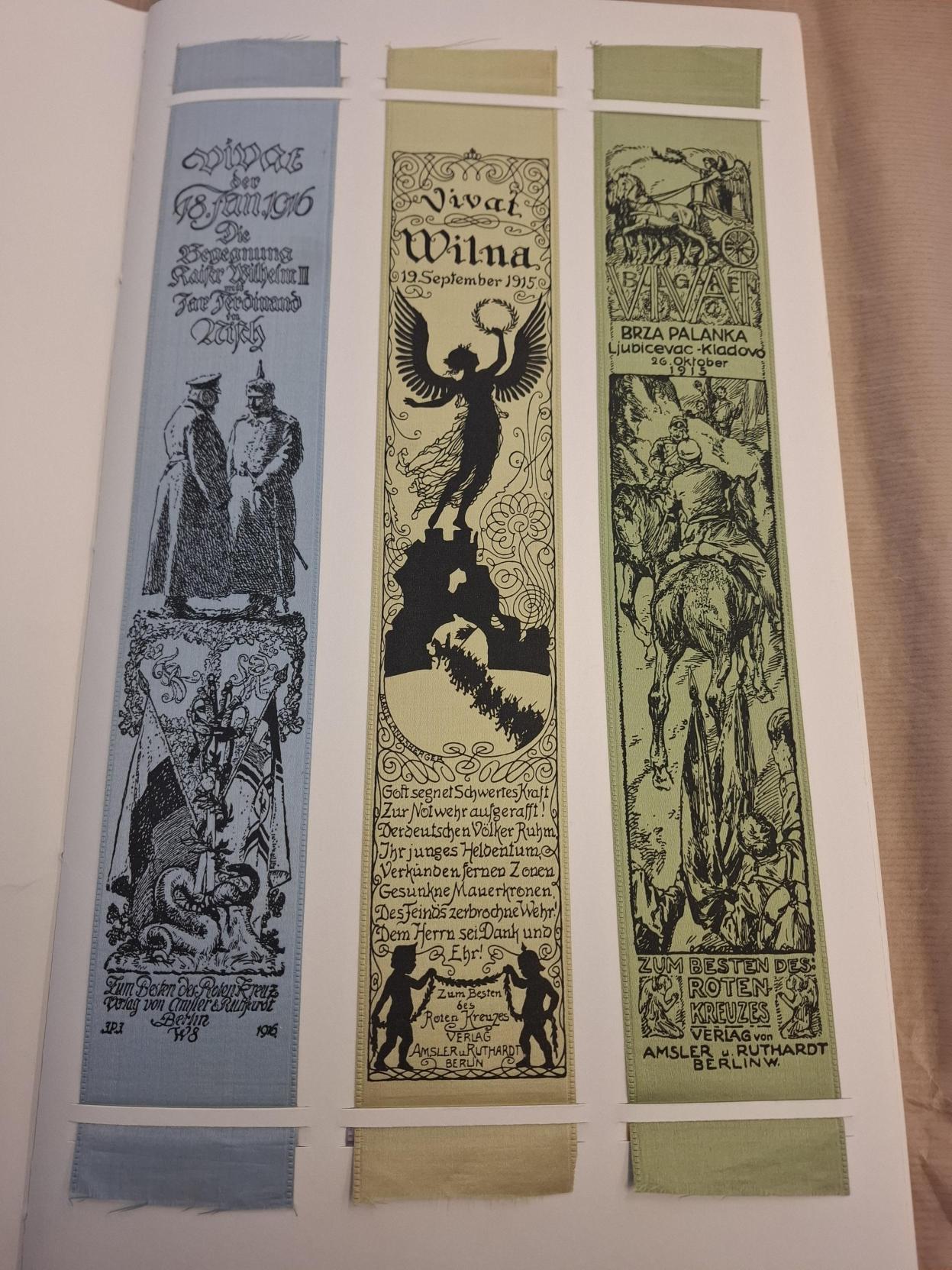
Inside the Peace Palace Library’s archives, we have discovered a small collection of various vivat ribbons of the time of the First World War (1914-1918). Many of them come from the Berlin publisher “Amsler und Ruthardt”. At the time some of the proceeds would go to the German Red Cross to support soldiers and many of the ribbons show artistic renderings of soldiers, generals or symbols of national pride or cultural significance. Many of them were dedicated to specific battles or army corps. They also feature patriotic slogans or poems such as:
"Gott segnet Schwertes Kraft, zur Notwehr aufgerafft! Der deutschen Völker Ruhm, Ihr junges Heldentum, Verkündet fernen Zonen Gesunkene Mauerkronen, Des Feindes zerbrechne Wehr! Dem Herrn sei Dank und Ehr!”
[English translation: “God blesses the sword’s strength, raised in self-defense! The glory of the German peoples. Their youthful heroism Proclaiming to distant lands Fallen city walls Shatter the enemy’s defenses! To the Lord be thanks and honor!”]
Others carry animosity or common narratives towards the enemy at the time:
“Nieder mit Serbien dem Weltbrandentzünder! Ein Hurra Unseren Truppen!”
[English translation: “Down with Serbia, the igniter of the world fire! A hurrah for our troops!”]
In reference to the assassination of Austrian Archduke Franz Ferdinand by the Serbian terrorist group the Black Hand.
Despite their nationalistic slogans they had in many cases the purpose to provide basic medical and humanitarian services to the soldiers on the front. To this day they offer us a look into the cultural and political narratives of the time.